Machine learning-based performance prediction in quantum queueing: comparative evaluation of tree and neural models for fidelity, heat and latency
- Original Research
- Published:
- (2026)
- Cite this article
Abstract
Abstrct
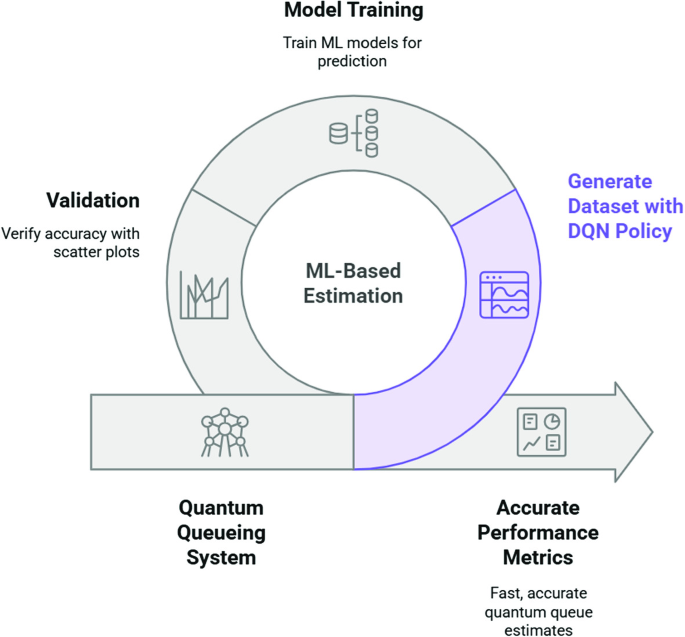
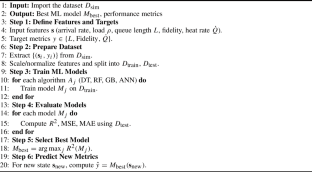
In this paper, we address the critical challenge of performance evaluation in complex quantum queueing systems, where traditional analytical methods are often mathematically intractable and direct simulation is computationally prohibitive. Initially, we formulate a comprehensive quantum queueing model incorporating entropy-dependent service degradation, thermodynamic feedback and multi-mode server dynamics and derive the steady-state probability equations using the supplementary variable technique. Subsequently, we propose a novel data-driven methodology that leverages Machine Learning (ML) techniques to provide fast and accurate predictions of key quantum-specific performance metrics. To achieve this, a comprehensive dataset is generated through offline simulations guided by a Deep Q-Network (DQN) policy, capturing the system dynamics under an optimized control strategy. Further, several ML models, including Decision Trees, Random Forests, Gradient Boosting and Artificial Neural Networks, are trained and comparatively evaluated to predict important performance measures such as average queue length, fidelity of quantum states and heat generation rate from the system parameters. Moreover, the proposed framework demonstrates outstanding predictive performance, with all models achieving exceptionally high accuracy and \(R^2\) values consistently exceeding 0.9995 across all target metrics. The predictive capability of the models is further validated through scatter plots comparing predicted and actual values, dependency plots illustrating the relationships between performance metrics and key input parameters (e.g., arrival rates and service rates) and detailed analyses of prediction errors. Finally, this work bridges the gap between quantum queueing theory and data-driven performance evaluation by integrating rigorous stochastic modeling with modern ML techniques, thereby providing an efficient, scalable and practical framework for the analysis, prediction and optimization of quantum technologies while explicitly accounting for quantum-specific constraints and thermodynamic costs.
Graphical Abstract
This is a preview of subscription content, log in via an institution to check access.
Access this article
Subscribe and save
- Starting from 10 chapters or articles per month
- Access and download chapters and articles from more than 300k books and 2,500 journals
- Cancel anytime
Buy Now
Price excludes VAT (USA)
Tax calculation will be finalised during checkout.
Instant access to the full article PDF.


Explore related subjects
Discover the latest articles, books and news in related subjects, suggested using machine learning.Data availability
Data are available upon request from the authors.
References
Begum, A., Choudhury, G., Sarma, H. J., & Kumar, N. (2025). Reliability analysis of an unreliable n-policy queue under bernoulli vacation schedule with two-service genres and optional repeated service. International Journal of Reliability, Quality and Safety Engineering, 32(04), 2550005.
Chaudhry, M., Banik, A., Dev, S., & Barik, S. (2025). A simple derivation of the waiting-time distribution (in the queue) for the bulk-service queueing system. Annals of Operations Research, 352(1), 1–24.
Chen, W. L., Koh, T., & Lin, J. H. (2025). Reliability analysis and sensitivity analysis of retrial machine repair problems with multiple vacations and the recovery policy. International Journal of Reliability, Quality and Safety Engineering, 32(01), 2450045.
Dai, W., Peng, T., & Win, M. Z. (2020). Quantum queuing delay. IEEE Journal on Selected Areas in Communications, 38(3), 605–618.
Devoret, M. H., & Schoelkopf, R. J. (2013). Superconducting circuits for quantum information: an outlook. Science, 339(6124), 1169–1174.
Dhibar, S., & Jain, M. (2025). Metaheuristic optimization and strategic behavior of markovian vacation queue with retrial policy: application to virtual call center. Evolutionary Intelligence, 18(1), 13.
Falin, G. (1990). A survey of retrial queues. Queueing systems, 7(2), 127–167.
Fiusa, G., & Landi, G. T. (2025). Queued quantum collision models. Physical Review A, 111(3), Article 032220.
Gaudenzi, R., Burzurí, E., Maegawa, S., Van Der Zant, H., & Luis, F. (2018). Quantum landauer erasure with a molecular nanomagnet. Nature Physics, 14(6), 565–568.
Gawron, P., Kurzyk, D., & Puchała, Z. (2013). A model for quantum queue. International Journal of Quantum Information, 11(02), 1350023.
Huang, C. Y., & Huang, W. C. (2008). Software reliability analysis and measurement using finite and infinite server queueing models. IEEE Transactions on Reliability, 57(1), 192–203.
Huang, Y., Tian, R., & Su, J. (2025). Model validation and strategy analysis in retrial queues with delayed vacations and feedback based on monte carlo simulation. Mathematics, 13(11), 1856.
Jagannathan, K., Chatterjee, A., & Mandayam, P. (2019). Qubits through queues: The capacity of channels with waiting time dependent errors. 2019 national conference on communications (ncc) (pp. 1–6).
Karthick, A., Ramaraj, E., & Kannan, R. (2013). An efficient tri queue job scheduling using dynamic quantum time for cloud environment (pp. 871–876) international conference on green computing, communication and conservation of energy (icgce).
Keerthana, R. (2025). An m/g/1 retrial queue with working vacation, non persistent customers and a waiting server. Reliability: Theory & Applications, 20(1 (82)), 1089–1099,
Krantz, P., Kjaergaard, M., Yan, F., Orlando, T. P., Gustavsson, S., & Oliver, W. D. (2019). A quantum engineer’s guide to superconducting qubits. Applied Physics Reviews, 6(2),
Kuo, C. C., Huang, K., Ke, J. C., Liu, T. H., & Sheu, S. H. (2025). Modelling and optimisation for a retrial queue with imperfect coverage and reboot delay. Journal of Control and Decision, 12(1), 123–130.
Liu, T. H., Chang, F. M., Ke, J. C., & Sheu, S. H. (2022). Optimization of retrial queue with unreliable servers subject to imperfect coverage and reboot delay. Quality Technology & Quantitative Management, 19(4), 428–453.
Liu, T. H., Hsu, H. Y., & Chang, F. M. (2025). Multi-server two-way communication retrial queue subject to disaster and synchronous working vacation. Algorithms, 18(1), 24.
Mandayam, P., Jagannathan, K., & Chatterjee, A. (2019). The classical capacity of a quantum erasure queue-channel. 2019 ieee 20th international workshop on signal processing advances in wireless communications (spawc) (pp. 1–5).
Mandayam, P., Jagannathan, K., & Chatterjee, A. (2020). The classical capacity of additive quantum queue-channels. IEEE Journal on Selected Areas in Information Theory, 1(2), 432–444.
Mathavavisakan, N. M., Indhira, K., & Ammar, S. I. (2025). Cost optimization and analysis of retrial queues with hybrid vacation policies and fault correction: A metaheuristic approach. RAIRO-Operations Research, 59(5), 2683–2720.
Mathavavisakan, N. M., Indhira, K., & Ammar, S. I. (2025). Optimizing energy harvesting in web of things services: a metaheuristic approach with retrial queue under working vacation. Soft Computing, 29(6), 2769–2790.
Moulai, R., Boualem, M., & Benrais, I. (2026). Analysis and performance evaluation of a bulk arrival retrial queue with impatient customers, server breakdowns, and bernoulli vacation policy. Mathematical Methods of Operations Research, 1–50.
Nguyen, T. P., Liao, Y. T., Lin, Y. K., & Chang, P. C. (2023). System reliability analysis for a stochastic liner container shipping service with stochastic terminals. International Journal of Reliability, Quality and Safety Engineering, 30(01), 2250019.
Poornima, R., & Kirupa, K. (2026). Supplementary variable technique approach on retrial queue with feedback and backup server during bernoulli’s lengthy vacation and random repairs. International Journal of Mathematics in Operational Research, 33(3), 361–390.
Rani, S., Jain, M., & Dhibar, S. (2026). Strategic behaviour on m/m/1 retrial queue with discouragement and working vacation. OPSEARCH, 1–28,
Roy, A., Pachuau, J.L., Singh, N.B., & Saha, A.K. (2024). Quantum inspired genetic algorithm and optimization of queuing delay. Tencon 2024-2024 ieee region 10 conference (tencon) (pp. 1929–1933).
Sampath, M. S., Sharma, D. K., & Gaur, A. (2023). Retrial queueing system subject to differentiated vacations with impatient customers. Applications of mathematical modeling, machine learning, and intelligent computing for industrial development (pp. 93–110). CRC Press.
Sanga, S. S., & Vankudothu, R. (2025). Modeling and optimization of an m/m/1/k/wv retrial queue with dual-phase service, customer’s balking under f-policy. RAIRO-Operations Research, 59(5), 2779–2803.
Shanmugam, B., M. C., & S. (2025). Unpredictable two-stage retrial model featuring impatient customers pinned bernoulli working vacations and starting failure. Annals of Operations Research, 1–30.
Squillante, M. S. (2022). On the quantum entanglement of random walks and queueing systems. Queueing Systems, 100(3), 253–255.
Stamatiou, G. T., & Magoutis, K. (2023). Quantum-enhanced control of a tandem queue system. Eai international conference on performance evaluation methodologies and tools (pp. 99–114)
Talbi, D., & Gal, Z. (2025). Higher-order markov model-based analysis of reinforcement learning in 6g mobile retrial queueing systems. Sensors, 25(23), 7245.
Talbi, D., & Gal, Z. (2025). Integrating reinforcement learning into m/m/1/k retry queueing models for 6g applications. Sensors, 25(12), 3621.
Talbi, D., & Gal, Z. (2025c). Reinforcement learning-enhanced retry queue system for unmanned systems in 6g networks. 2025 ieee international conference on unmanned systems (icus) (pp. 1242–1247).
Tao, M., Xu, J., Zhang, S., Tan, J., & Xu, J. (2024). Precision sensitivity optimization for parallel robotic system based on multi-source preventive maintenance. International Journal of Reliability, Quality and Safety Engineering, 31(05), 2450019.
Tian, N., & Zhang, Z.G. (2006). Vacation queueing models: theory and applications (Vol. 93). Springer Science & Business Media.
Trivedi, K. S., & Geist, R. M. (1983). Decomposition in reliability analysis of fault-tolerant systems. IEEE Transactions on Reliability, 32(5), 463–468.
Vishnevsky, V., Klimenok, V., Sokolov, A., & Larionov, A. (2021). Performance evaluation of the priority multi-server system mmap/ph/m/n using machine learning methods. Mathematics, 9(24), 3236.
Wang, L., Zhao, X., & Pham, H. (2025). Novel formulations and metaheuristic algorithms for predictive maintenance of aircraft engines with remaining useful life prediction. Reliability Engineering & System Safety, 261, Article 111064.
Wang, L., Zhu, Z., & Zhao, X. (2025). Dynamic predictive maintenance decisions based on system remaining useful life prediction and three inspection strategies. International Journal of Reliability, Quality and Safety Engineering, 32(04), 2550011.
Wilde, M. M. (2013). Quantum information theory. Cambridge University Press.
Zubeldia, M., Jhunjhunwala, P. R., & Maguluri, S. T. (2026). Matching queues with abandonments in quantum switches: Stability and throughput analysis. Operations Research, 74(1), 339–355.
Acknowledgements
Not applicable.
Funding
Not applicable.
Author information
Authors and Affiliations
Department of Business Administration, Asia University, Taichung, Taiwan
N. Micheal Mathavavisakan & Shey-Huei Sheu
Department of Mathematics, Faculty of Engineering and Technology, SRM Institute of Science and Technology, Chennai, Tamil Nadu, 600089, India
M. Lakshmi
Department of Medical Research, China Medical University Hospital, China Medical University, Taichung, Taiwan
Shey-Huei Sheu
- N. Micheal Mathavavisakan
Search author on:PubMed Google Scholar
- M. Lakshmi
Search author on:PubMed Google Scholar
- Shey-Huei Sheu
Search author on:PubMed Google Scholar
Contributions
All the authors made substantial contributions to the conception or design of the work.
Corresponding author
Correspondence to Shey-Huei Sheu.
Ethics declarations
Conflict of interest
The authors report no conflict of interest.
Additional information
Publisher's Note
Springer Nature remains neutral with regard to jurisdictional claims in published maps and institutional affiliations.
Rights and permissions
Springer Nature or its licensor (e.g. a society or other partner) holds exclusive rights to this article under a publishing agreement with the author(s) or other rightsholder(s); author self-archiving of the accepted manuscript version of this article is solely governed by the terms of such publishing agreement and applicable law.
About this article
Cite this article
Micheal Mathavavisakan, N., Lakshmi, M. & Sheu, SH. Machine learning-based performance prediction in quantum queueing: comparative evaluation of tree and neural models for fidelity, heat and latency. Ann Oper Res (2026). https://doi.org/10.1007/s10479-026-07421-5
Received:
Accepted:
Published:
Version of record:
DOI: https://doi.org/10.1007/s10479-026-07421-5
Provided by the Springer Nature SharedIt content-sharing initiative
Keywords
Mathematics Subject Classification
Profiles
- N. Micheal Mathavavisakan View author profile
- M. Lakshmi View author profile
- Shey-Huei Sheu View author profile